What Do the Numbers on a Camera Lens Mean?
What the numbers on a camera lens mean is usually focal length and maximum aperture. The numbers help you understand the view and light range; letters often identify the mount, focus motor, or stabilization.
On this page (10 sections)
- What do the numbers on a camera lens mean?
- What does mm mean on a camera lens?
- What does f/1.8 or f/4.5-6.3 mean?
- Do lens numbers tell you whether it fits your camera?
- What do STM and OSS mean on a lens?
- How should you choose a lens from its numbers?
- What should you check before your first shoot?
- What mistakes should you avoid when reading lens markings?
- How do you care for a camera lens?
- Which lens marking should you check first?
What the numbers on a camera lens mean is usually focal length and maximum aperture. A label such as 16mm f/1.4 tells you the lens's view and widest opening, while letters often identify the mount, focusing system, or stabilization.
A 16mm f/1.4 lens has one focal length and a wide maximum aperture. A 55-210mm f/4.5-6.3 lens zooms through a range, and its widest opening gets smaller as you zoom in.
What do the numbers on a camera lens mean?
The first number usually shows focal length in millimeters, and the f-number shows maximum aperture. Read both to compare the lens's view, its widest opening, and how its framing changes.
A prime lens has one focal length, such as 50mm. A zoom lens has a range, such as 55-210mm: the lower number gives the widest view and the higher number gives the tightest view.
The f-number describes how wide the lens can open. A smaller number like f/1.4 means a wider maximum opening than f/4.5, which can let in more light and make it easier to blur the background.
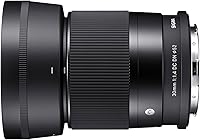
For a Sony E-mount camera, the Sigma 16mm f/1.4 is a fixed wide-angle choice for nature, events, and dim scenes. Skip it if you need to zoom between distant subjects or your camera uses a different mount.
What does mm mean on a camera lens?
Millimeters describe focal length, which affects how wide or tight the scene appears through the viewfinder. A shorter focal length usually fits more of the scene, while a longer one brings distant subjects closer in the frame.
A 16mm lens gives a broad view that can suit landscapes, events, and indoor scenes where space is tight. A 50mm lens frames a narrower portion of the scene and can work well for portraits or everyday pictures.
On an APS-C camera, the angle of view appears tighter than on a full-frame camera using the same focal length. For more on that difference, read what APS-C means on a camera.
What do 55-210mm numbers on a camera lens mean?
A 55-210mm marking means the lens can zoom from 55mm to 210mm. At the shorter end it shows more of the scene; at the longer end, distant subjects take up more of the frame.
The Sony E 55-210mm is designed for Sony APS-C E-mount cameras. Its 35mm-equivalent range is 82.5mm to 315mm, covering medium telephoto through telephoto framing.
This zoom suits Sony APS-C users who photograph sports or nature and want to adjust framing from their position. Skip it if you need a wide view for small rooms or a lens for a non-Sony E-mount camera.
The range can help when you can't move closer to your subject. For camera ideas for birds and backyard wildlife, see best cameras for birding and backyard birds.
What does f/1.8 or f/4.5-6.3 mean?
The f-number shows the maximum aperture, or widest opening, available on the lens. A lower number means a wider opening, which can let in more light and create a shallower area of focus.
The Canon EF 50mm f/1.8 STM has a fixed focal length and is made for Canon EF cameras. On APS-C cameras, its effective focal length is 80mm, giving a tighter view than it does on a full-frame camera.
This prime suits Canon EF users who want a simple portrait or everyday lens, including people who shoot in dimmer settings. Skip it if you need a zoom or want a broad view in tight indoor spaces.
A zoom marked f/4.5-6.3 has a variable maximum aperture. It can open to f/4.5 at the wide end and f/6.3 at the long end, so less light reaches the sensor as you zoom in.
For more on how aperture affects exposure and background blur, read what aperture means on a camera.
Do lens numbers tell you whether it fits your camera?
The mount marking matters most for physical and electronic compatibility. Match the mount to your camera system, then confirm that the exact camera model supports the lens.
A lens marked Sony E fits Sony E-mount cameras when the camera supports that lens type. Canon EF lenses are made for Canon EF mount cameras; an adapter may allow use on another system, but it doesn't guarantee that every feature will work.
Don't rely on the camera brand alone. Check the exact mount and camera model, especially when choosing a lens for a camera such as the one in our guide to best lenses for the Sony A6400.
What do STM and OSS mean on a lens?
STM identifies a stepping motor, while OSS refers to Sony Optical SteadyShot stabilization. These letters describe features beyond focal length and aperture.
The Canon EF 50mm f/1.8 STM has a stepping motor that supports near-silent continuous focusing for movies and smooth autofocus for still photos. The initials describe its focusing system, but don't tell you whether the lens fits every Canon camera.
The Sony E 55-210mm includes Optical SteadyShot, which can help reduce camera shake in stills or video. Stabilization can help when you shoot handheld, but steady framing and appropriate shutter speed still matter.
How should you choose a lens from its numbers?
Start with mount, then choose a focal length and aperture that suit your subjects. That order avoids choosing a lens for its view or light range before confirming that it fits your camera.
Pick a shorter focal length when you want more of a landscape, room, or group in the frame. Pick a longer focal length when you want distant subjects to appear larger, and consider a zoom if you want to change framing without changing lenses.
A lower maximum f-number can help when you photograph in dim light or want a softer background. If you mainly shoot outdoors in bright conditions, you may value a useful focal-length range more than the widest possible aperture.
For a fixed wide view on a Sony E camera, the Sigma 16mm f/1.4 suits landscapes, events, and low-light scenes. For Canon EF, the 50mm f/1.8 is a compact prime for portraits and everyday pictures; Sony APS-C users who want distant subjects closer should consider the 55-210mm zoom.
What should you check before your first shoot?
Confirm the camera mount, attach the lens securely, and remove the front and rear caps before shooting. Start with a familiar subject so you can see how the focal length changes the framing.
If you're using a zoom, try the short end and long end from the same position. The change in framing makes the lens's range easier to understand, and you'll see whether you need to step back or forward to compose the scene you want.
For a prime lens, remember that the view stays fixed. Move yourself to change the framing, and make sure you have enough room before choosing a wide or longer focal length for an indoor scene.
When using a long zoom handheld, hold the camera and lens steadily and check the image before moving on. Optical stabilization can help with camera shake, but it doesn't freeze a moving subject.
What mistakes should you avoid when reading lens markings?
Don't confuse focal length with the camera's zoom setting, or assume a lower f-number is always the best choice. Each marking answers a different buying question.
A single focal length like 50mm doesn't mean the lens is a zoom. A range such as 55-210mm does, and the maximum aperture may change across it.
Also check whether you're comparing lenses for APS-C or full-frame framing. The camera's sensor size affects the angle of view, so the same millimeter marking won't always give the same composition across camera systems.
Finally, don't assume that a mount adapter guarantees autofocus or stabilization will work. Confirm compatibility for your camera and lens combination before buying.
How do you care for a camera lens?
Keep the caps on when the lens isn't attached to the camera, and clean the glass gently when it needs it. A clean front element helps you avoid dust or smudges showing in your pictures.
Avoid touching the glass with your fingers, and don't wipe grit across the surface. Use a clean lens cloth or suitable lens-cleaning tools, following the steps in how to clean a camera lens.
Which lens marking should you check first?
Check the mount first, then compare focal length and maximum aperture. Choose the Sigma 16mm f/1.4 for a wide Sony E-mount view and a bright aperture, the Canon EF 50mm f/1.8 for portraits and everyday framing, or the Sony E 55-210mm when a Sony APS-C camera needs telephoto reach.
Pick a shorter focal length for more of the scene, a longer one for distant subjects, and a lower f-number when you need a wider maximum aperture. Before buying, confirm that the lens mount and your exact camera model are compatible.
Frequently asked questions
What do the numbers on a camera lens mean?
Lens numbers usually show focal length in millimeters and maximum aperture as an f-number, such as f/1.8. A range like 55-210mm marks a zoom lens; a single number like 50mm usually marks a prime lens with one focal length.
Check the mount markings too, because the lens must match your camera system.
What does mm mean on a camera lens?
Millimeters show a lens's focal length, which affects how much of a scene fits in the frame and how large distant subjects appear. Smaller numbers usually give a wider view, while larger numbers give a tighter view.
Sensor size also affects the angle of view you get from that focal length.
What does f/1.8 mean on a lens?
F/1.8 is the lens's maximum aperture, or widest opening. A lower f-number means the lens can open wider, which can let in more light and create shallower depth of field.
It doesn't mean the camera always shoots at f/1.8; you can select a smaller aperture.
What do the letters on a camera lens mean?
Letters are brand-specific abbreviations for lens mount, focus motor, stabilization, or design. For example, STM refers to Canon's stepping motor, and OSS means Sony Optical SteadyShot stabilization.
Check your camera maker's compatibility guidance before buying, since similar letters can mean different things across brands.