7 Best Fujifilm Cameras for Beginners (November 2026)
The best Fujifilm cameras for beginners include the Fujifilm X-T30 III Kit for first-time learners, the Fujifilm X-S20 Kit for handheld video, and the Fujifilm X-M5 Kit for compact creators.
On this page (6 sections)
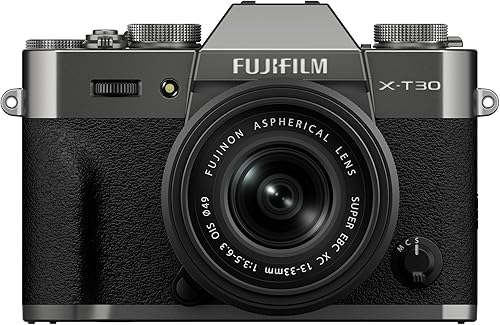
The Fujifilm X-T30 III Kit is the best Fujifilm camera for beginners who want an approachable first setup. It has an Auto mode, a zoom lens, a compact body and creative Film Simulations, so you can start with simple settings and build skill over time.
The other kits suit more specific needs. The X-S20 gives you a deep grip and in-body stabilization, the X-M5 brings compact creator features, and the higher-resolution bodies offer different controls and image options.
Fujifilm X Series interchangeable-lens cameras use the Fujifilm X mount. Your first decision is less about buying the most advanced body and more about choosing a camera and lens setup you will enjoy carrying and learning.
If you are still weighing camera types, begin with our guide to DSLR, mirrorless and zoom cameras for beginners. You can also compare the controls and lens systems in our guides to Canon cameras for beginners and Nikon cameras for beginners.
Our picks at a glance
-
1
-
2

-
3

Which Fujifilm camera is best for beginners?
The X-T30 III Kit is the best Fujifilm camera for most beginners because it combines Auto mode, a zoom lens and room to explore manual controls. The X-S20 and X-M5 are stronger matches if handheld video or creator features are high on your list.
Fujifilm X-T30 III Kit: Best for first-time learners
- Auto mode
- 20 Film Simulations
- Compact body
- XC 13-33mm OIS kit lens
- AI-powered subject detection autofocus
A compact kit with a zoom lens, an Auto mode and 20 Film Simulations lets a beginner start simply and explore creative settings later.
Pros
- Auto mode
- 20 Film Simulations
- AI-powered subject detection autofocus
Cons
- The kit lens has a variable f/3.5-6.3 aperture
- No in-body stabilization detail is available
The X-T30 III Kit makes sense if you want to begin in Auto mode and learn manual controls at your own pace. Its compact body and XC 13-33mm OIS zoom lens give you a flexible starter setup, while 20 Film Simulations let you try different color styles in camera.
AI-powered subject detection autofocus can help follow a subject while you compose. The camera also has 425 autofocus points, giving you options as you learn to place focus deliberately.
Choose this kit if you want one camera for daily photos, family scenes, travel and learning. Skip it if you know you want a deep handgrip, built-in stabilization or advanced video tools; the X-S20 is a better fit for those priorities.
The lens has a variable f/3.5-6.3 aperture, so available light and your settings still matter. For a closer look at its controls, see our Fujifilm X-T30 III review.
Fujifilm X-S20 Kit: Best for handheld video
- 26.1 MP stills
- Deep handgrip
- Up to seven stops of in-body stabilization
- 180-degree vari-angle touchscreen
- XC 15-45mm kit lens
A deep grip, vari-angle touchscreen and in-body stabilization suit beginners who want a comfortable handheld camera for photos and video.
Pros
- Deep handgrip
- Vari-angle touchscreen
- Up to seven stops of in-body stabilization
Cons
- Its video features may be more than stills-first beginners need
- The kit lens has a variable f/3.5-5.6 aperture
The X-S20 Kit suits beginners who want a comfortable grip for handheld shooting. Its five-axis in-body image stabilization is rated up to seven stops, and the deep handgrip supports a secure hold even with a larger lens attached.
The 180-degree vari-angle touchscreen can face forward for selfie-style video or angle down and up for creative framing. Auto Subject Detection AF and the 15-45mm kit lens give you useful starting points for everyday photos.
This model is a strong pick if you plan to make video as well as still photos. It can record internally up to 6.2K/30p in 4:2:2 10-bit color, and Vlog mode is designed to simplify common creator tasks.
Choose the X-S20 if a stable handheld setup and video options matter to you. Skip it if you mainly want to learn still photography with basic controls and a simple kit, because the X-T30 III covers that path with fewer video features to sort through.
Its 491 g body weight and larger grip may feel reassuring if small cameras are hard to hold. The 15-45mm lens has a variable f/3.5-5.6 aperture.
Fujifilm X-M5 Kit: Best for compact creators
- 26.1 MP APS-C sensor
- 20 Film Simulations
- XC 15-45mm OIS PZ kit lens
- 6K video recording
- Three onboard microphones
This compact interchangeable-lens kit pairs a zoom lens and touchscreen with video features for beginners who want both photos and creator content.
Pros
- 20 Film Simulations
- Three onboard microphones
- Optically stabilized kit lens
Cons
- No built-in flash
- Video features may take time to learn
The X-M5 Kit suits a beginner who wants an interchangeable-lens camera for both photos and creator content. Its XC 15-45mm OIS PZ lens, touchscreen and three onboard microphones support a compact setup for filming yourself or recording everyday scenes.
The 26.1 MP APS-C sensor is a sensible resolution for learning without making high pixel counts the main reason to buy. The camera includes 20 Film Simulations, with eight available through a dedicated top dial, plus AI-powered autofocus and 6K video recording.
Pick this kit if portability and video features are central to your plans. Skip it if you need a built-in flash or if you want a grip-focused body for long handheld sessions; the X-S20 is the more natural choice for that.
The included lens has optical image stabilization, which can help reduce the effect of camera shake. Keep a spare battery and enough memory card space on hand for longer video sessions.
Fujifilm X-T50 Kit: Best for frequent cropping

- 40.2 MP sensor
- Dedicated Film Simulation dial
- XC 15-45mm OIS PZ kit lens
- In-body stabilization up to seven stops
- 6.2K/30P video
The 40.2 MP sensor and dedicated Film Simulation dial suit a beginner who wants detailed files and quick access to Fujifilm color looks.
Pros
- 40.2 MP sensor
- Dedicated Film Simulation dial
- In-body stabilization
Cons
- More resolution than many first-time photographers need
- The kit lens has a variable f/3.5-5.6 aperture
The X-T50 Kit suits a beginner who expects to crop images or wants fast access to Fujifilm Film Simulations. Its 40.2 MP sensor records more image detail than the 26.1 MP models in this guide, and the dedicated dial gives direct access to 20 Film Simulations.
The 15-45mm OIS PZ kit lens covers a useful range for everyday scenes. In-body stabilization is rated up to seven stops, and video options include 6.2K/30P and 4K/60P.
Choose the X-T50 if you have a clear reason to want higher resolution, such as frequent cropping or detailed still images. Skip it if your main goal is to learn exposure and composition on an uncomplicated kit; the X-T30 III is the simpler first step.
Resolution is only one part of image quality. Focus, light, lens choice and steady technique shape the result too, so don't buy more megapixels unless you expect to use them.
Fujifilm X-E5 Kit (23mm): Best for one-lens practice

- 40.2 MP sensor
- XF 23mm f/2.8 lens
- Customizable Film Simulation dial
- Up to seven stops of in-body stabilization
- Electronic viewfinder
The included 23mm lens gives you one angle of view to learn, and the X-E5 can accept other X Mount lenses as your needs change.
Pros
- 40.2 MP sensor
- Included 23mm lens
- Customizable Film Simulation dial
Cons
- The kit starts with one focal length
- No built-in flash
The X-E5 Kit starts with an XF 23mm f/2.8 lens, making it a good fit for a beginner who wants to practice with one everyday angle of view. Its rangefinder-style body has analog controls, an electronic viewfinder and a customizable Film Simulation dial.
The 40.2 MP sensor gives you room to crop, and in-body stabilization is rated up to seven stops at the center of the frame and six stops at the edges. You can also change lenses later because the camera accepts Fujifilm X Mount optics.
Pick this kit if you want a stills-focused camera that encourages deliberate framing. Skip it if you often photograph distant subjects, sports or scenes where you cannot move; a zoom kit will give you more framing options from one position.
A single focal length can help you notice how distance and composition change a picture. Before buying, consider whether you are comfortable walking closer or farther away instead of turning a zoom ring.
Fujifilm X-T5 Kit: Best for dial-control fans

- 40.2 MP sensor
- XF 16-50mm weather-resistant lens
- Up to seven stops of in-body stabilization
- 15 fps mechanical shutter
- Three-way tilting LCD
The X-T5 combines a versatile zoom kit with advanced stills features for a beginner who wants direct controls and plans to grow into them.
Pros
- 40.2 MP sensor
- Weather-resistant kit lens
- Three-way tilting LCD
Cons
- Advanced features can add complexity
- No built-in flash
The X-T5 Kit suits a beginner who wants direct dial controls and expects to grow into advanced still photography. Its 40.2 MP sensor and XF 16-50mm lens combine high resolution with a wide-to-standard zoom range.
The body offers up to seven stops of in-body stabilization, a three-way tilting LCD and a mechanical shutter that shoots up to 15 frames per second. The included lens is weather-resistant and has an f/2.8-4.8 aperture range.
Choose this kit if you already have a specific reason to value its high-resolution stills tools and direct controls. Skip it if you are unsure what you need from a camera; the X-T30 III is easier to recommend as a first interchangeable-lens setup.
A feature-rich camera can make learning feel harder if you change many settings at once. Start with one shooting mode and one subject, then add features only when you can name the problem they solve.
Fujifilm X100VI: Best for fixed-lens travel

- 40.2 MP stills
- Fixed 23mm lens
- Hybrid viewfinder
- Up to six stops of in-body stabilization
- 20 Film Simulations
The fixed lens keeps the camera self-contained and offers one angle of view to learn, but it cannot change lenses as your photography develops.
Pros
- Fixed 23mm lens
- Hybrid viewfinder
- 20 Film Simulations
Cons
- Lens cannot be changed
- Less flexible than an interchangeable-lens kit
The X100VI suits a beginner who wants a self-contained camera and likes the view from a fixed 23mm lens. Because the lens cannot be changed, the camera keeps your kit simple while you learn to frame scenes from one position.
It has 40.2 MP resolution, a hybrid viewfinder, 20 Film Simulations and up to six stops of in-body stabilization. It can also record video up to 6.2K/30P and 4K/60P.
Choose the X100VI if its fixed view matches how you expect to photograph, such as daily scenes and travel. Skip it if you want to learn with a zoom or explore different focal lengths; the X-T30 III or another interchangeable-lens kit will adapt as your interests change.
A fixed lens removes lens decisions, but it also limits how tightly you can frame a distant subject. Think about the subjects you photograph most before settling on this camera.
How should you choose a first Fujifilm camera?
Choose your lens setup and main use before comparing resolution or advanced features. A zoom kit fits varied everyday scenes, a single-lens kit keeps your choices focused, and a fixed-lens camera is the simplest setup to carry.
Is a zoom lens or a fixed lens better for beginners?
A zoom lens is the more flexible choice when subjects vary in distance or you cannot move around freely. The X-T30 III's 13-33mm lens and the X-S20, X-M5 and X-T50 15-45mm kits let you adjust framing from one spot.
The X-E5 starts with an interchangeable 23mm lens, while the X100VI has a fixed 23mm lens. Those cameras ask you to move to change perspective, and the X100VI cannot accept another lens.
If you are unsure which lens type will suit you, start with a zoom. It makes family gatherings, travel scenes and nearby subjects easier to frame without stopping to change gear.
What should a beginner know about stabilization?
In-body stabilization can reduce blur caused by camera movement during handheld shooting. The X-S20, X-T50, X-E5, X-T5 and X100VI list in-body stabilization, with the X-T30 III kit offering a lens with optical stabilization.
Stabilization does not freeze a moving subject. For sports, active children or pets, shutter speed and autofocus still matter, so look at a camera's focus tools and practice tracking movement as well.
Is a 40.2 MP camera worth it for a beginner?
A 40.2 MP camera gives you more resolution for detailed images and cropping, but most beginners can learn with 26.1 MP. The X-T30 III, X-S20 and X-M5 all offer 26.1 MP.
Choose the X-T50, X-E5, X-T5 or X100VI if you expect to crop often or have a clear stills goal that benefits from higher resolution. Otherwise, a comfortable grip and suitable lens are more useful first priorities.
Should video features shape your first camera choice?
Video features should matter when you expect to make video regularly. The X-S20 and X-M5 offer creator-focused features, while the X-T50, X-T5 and X100VI also support high-resolution recording.
If you mostly want still photos, do not let a long video specification list steer you away from a camera that feels easier to learn. Choose the body around your main use, then treat video as an extra if you will use it.
How do you set up a Fujifilm camera for the first time?
Start with a charged battery, a formatted memory card and a clean, securely attached lens. Keep the camera in Auto mode for your first outings so you can focus on framing, focus and light before changing several settings.
Set the date and time, select JPEG or a file option you understand, and take a few practice pictures of still subjects. Check that the focus point lands where you want it, then review the image at full size on the camera screen.
Try one Film Simulation at a time and compare its effect on a familiar subject. If your camera has a touchscreen or a forward-facing screen, practice the controls at home before relying on them for a moment you cannot repeat.
When you are ready to learn exposure, change one setting and observe the result. Our guides explain aperture, shutter speed and ISO.
What beginner camera mistakes are easy to avoid?
The most common early mistake is changing several settings at once, then not knowing which change affected the photo. Make one adjustment at a time and take a second picture from the same position.
A second mistake is expecting stabilization to stop subject movement. Stabilization addresses camera shake, while a faster shutter speed helps freeze a moving person or animal.
Beginners can also buy a high-resolution body before knowing whether they need it. If you mostly share photos on screens and make ordinary prints, start by learning focus and composition with the camera that fits your needs.
Finally, avoid leaving a lens exposed while you decide what to shoot. Attach the cap when the camera is stored, keep dust away from the lens mount during changes, and carry the camera in a padded bag.
How should you care for and use a beginner Fujifilm camera?
Keep the lens capped when you are not shooting and use a clean, dry cloth for fingerprints on the camera body. Avoid touching the glass with your fingers, and store the camera with the lens attached or both body and lens caps in place.
When changing lenses, point the camera mount downward and make the change in a clean area if possible. This limits the time dust can enter the camera, and a quick, deliberate change is easier than leaving the body open while you search for a lens.
Charge the battery before a long outing and bring a spare memory card if you plan to record video. Video files take more card space than still photos, so check remaining capacity before an important shoot.
For lens care, follow our guide on how to clean a camera lens. Use a blower or proper lens cloth made for camera optics, and avoid household cleaners.
Which Fujifilm camera should a beginner choose?
Choose the X-T30 III Kit if you want the best Fujifilm camera for beginners who need an easy start, a zoom lens and room to learn. Choose the X-S20 for a deeper grip and stabilization, or the X-M5 if compact video creation is part of your plan.
Pick the X-T50 if you know you want higher-resolution files and direct Film Simulation access. The X-E5 suits one-lens practice with room to change lenses, while the X-T5 fits someone who wants advanced stills controls from the start.
Choose the X100VI only if you are happy to use one fixed 23mm view. For most first-time buyers, the X-T30 III is the clearest balance of simple setup and flexibility, and our X-T30 III review covers it in more detail.
Our top 3 picks at a glance
-
1
-
2
-
3
Frequently asked questions
Which Fujifilm camera is easiest for a beginner?
The Fujifilm X-T30 III Kit is the easiest starting point for most beginners because it has an Auto mode and comes with a zoom lens. You can begin with automatic settings, then explore the manual controls and Film Simulations as you learn.
Choose the X-S20 instead if you want a deeper grip and in-body stabilization.
Should a beginner choose a Fujifilm kit with a zoom lens?
A zoom lens lets you change framing without switching lenses, which helps with everyday scenes, family photos and travel. The X-T30 III, X-S20, X-M5 and X-T50 kits include zoom lenses.
The X-E5 starts with an interchangeable 23mm lens, while the X100VI has a fixed 23mm lens.
Is the Fujifilm X100VI a good first camera?
The X100VI can suit a beginner who wants a compact camera and is happy to use its fixed 23mm lens. Its hybrid viewfinder and 20 Film Simulations give you ways to compose and shape images.
Pick an interchangeable-lens kit if you want to try different focal lengths later.
Do beginners need a 40.2 MP Fujifilm camera?
Most beginners can learn photography with a 26.1 MP camera such as the X-T30 III, X-S20 or X-M5. The 40.2 MP models give you more resolution, which can help if you crop often, but resolution does not replace practice with focus, light and composition.
Choose based on the pictures you plan to make.