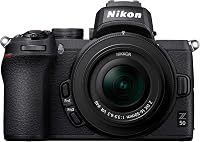
Canon R100 vs R50: Budget Mirrorless Showdown (November 2026)
The Canon EOS R50 is the better overall choice for most buyers, while the EOS R100 suits simple still photography on a tighter budget. The R50 leads in autofocus, screen movement, video and shooting speed.
On this page (11 sections)
- Canon R100 vs R50: what is the quick verdict?
- How do the Canon R100 and R50 compare side by side?
- Which camera gives you better image quality?
- Which Canon has the better autofocus?
- Which camera is better for video?
- Which camera is easier to frame with?
- Which camera is faster for action?
- Who should buy the Canon EOS R50?
- Who should buy the Canon EOS R100?
- How should you choose between the R100 and R50?
- Canon R100 vs R50: final verdict
The Canon EOS R50 is the better overall choice for most buyers, while the EOS R100 suits simple still photography on a tighter budget. The Canon R100 vs R50 decision depends on how much you value autofocus coverage, video control, screen movement and fast shooting.
Both kits pair an APS-C mirrorless camera with the Canon RF-S18-45mm F4.5-6.3 IS STM lens. That shared lens gives you a compact 18-45mm zoom range for everyday photos, family scenes and beginner practice.
The R100 still makes sense when you want an entry-level interchangeable-lens camera without placing video or action features first. The R50 earns its higher score by giving you more control over moving subjects, recording modes and composition.

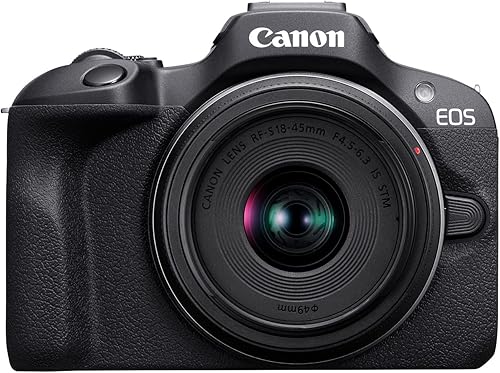
Canon R100 vs R50: what is the quick verdict?
Pick the Canon EOS R50 for most people. Its 24.2 MP APS-C sensor, DIGIC X processor, 651 autofocus points, vari-angle touchscreen and faster shooting give it a wider useful range than the R100.
Choose the Canon EOS R100 when you mainly want still photos and prefer a compact starting point for Canon RF lenses. Its 24.1 MP APS-C sensor keeps image resolution close to the R50, so the main gap is not basic pixel count.
The R50 is the stronger match for people who plan to record themselves, follow moving subjects or frame photos from low and high angles. Its 6K oversampled uncropped 4K recording reaches 30 fps, and its LCD can articulate for more flexible composition.
The R100 is the simpler choice for casual still photography, travel practice and learning interchangeable-lens basics. Its fixed LCD and slower burst rate narrow its range, but its core camera format remains useful for a new photographer.
Our Canon Rebel T7 vs R100 comparison gives another entry-level Canon comparison if you are deciding between a traditional DSLR-style option and the R100.
How do the Canon R100 and R50 compare side by side?
The R50 leads in the features that affect action, video and shooting angles, while the R100 keeps the basic still-photo experience close. Their shared lens and APS-C format make the differences easier to isolate.
| Product | Best for | Still resolution | Processor | Continuous shooting | Our score |
|---|---|---|---|---|---|
| Canon EOS R50 Kit (RF-S 18-45mm) | most mirrorless buyers | 24.2 MP | DIGIC X | 12 fps electronic first curtain, 15 fps electronic | 8.8 |
| Canon EOS R100 Kit (RF-S 18-45mm) | simple still photography | 24.1 MP | DIGIC 8 | Up to 6.5 fps with One-Shot AF | 8.3 |
| Feature | Canon EOS R50 | Canon EOS R100 |
|---|---|---|
| Kit lens | RF-S18-45mm F4.5-6.3 IS STM | RF-S18-45mm F4.5-6.3 IS STM |
| Sensor | 24.2 MP CMOS APS-C | 24.1 MP CMOS APS-C |
| Processor | DIGIC X | DIGIC 8 |
| Autofocus points | 651 | 143 |
| Autofocus | Contrast Detection, Phase Detection | Phase Detection |
| Continuous shooting | 12 fps electronic first curtain, 15 fps electronic | Up to 6.5 fps with One-Shot AF |
| Highest listed video mode | 6K oversampled uncropped 4K up to 30 fps | 4K up to 24 fps |
| Full HD slow motion | Up to 120 fps | Up to 60 fps |
| Screen | Vari-angle touchscreen | Fixed LCD |
| Viewfinder | 2.36-million-dot EVF | LCD viewing |
| Wireless connection | Bluetooth and Wi-Fi | Bluetooth, USB and Wi-Fi |
The R50 has a larger feature advantage than its small still-resolution lead suggests. The R100 has 24.1 MP, only 0.1 MP below the R50, but the R50 adds a DIGIC X processor, broader autofocus coverage and more flexible video.
Which camera gives you better image quality?
The R50 has the higher listed still resolution, but both cameras use an APS-C sensor suited to learning interchangeable-lens photography. The R50 uses a 24.2 MP CMOS APS-C sensor, while the R100 uses a 24.1 MP CMOS APS-C sensor.
That difference is too small to decide the purchase by itself. Both cameras give you enough resolution for everyday photographs, and both pair with the same RF-S18-45mm F4.5-6.3 IS STM kit lens.
The R50 adds a DIGIC X processor, compared with DIGIC 8 in the R100. The processor difference matters more when you use the cameras for autofocus, burst shooting and video than when you compare the headline megapixel figures.
The R100 remains a sensible first camera for someone who wants to move beyond a phone and learn aperture priority or manual exposure. Its listed aperture modes include Aperture Priority and Manual, while the R50 lists Av and M.
If you want the stronger overall image-making platform, choose the R50. If your main goal is to learn composition, lens choice and exposure with still subjects, the R100 supplies the closer match.
Which Canon has the better autofocus?
The R50 wins autofocus by a wide margin. Its Dual Pixel CMOS AF II covers up to 100% by 100% of the area with 651 AF zones, plus automatic subject detection and tracking for people, animals and vehicles.
That coverage gives the R50 more room to keep a subject under an autofocus point. It is the better choice for children moving through a room, pets, vehicles and video subjects who do not stay in the center of the frame.
The R100 has Dual Pixel CMOS AF with up to 143 zones and human face and eye detection. Its autofocus also includes animal and vehicle detection for stills and video, so it is not limited to basic center-focused shooting.
The difference is coverage and processing range. The R100 can handle common subjects, but the R50 gives you more autofocus zones and a more advanced Dual Pixel CMOS AF II system.
Canon R100 vs R50 autofocus for beginners
A beginner may notice the R50 advantage when a subject moves toward the edge of the frame. The broader 651-zone system makes it easier to keep composition loose instead of placing every subject in the center.
The R100 still works well as a learning camera for posed portraits, landscapes and everyday scenes. Choose it for those subjects when the lower score reflects a simpler brief rather than a need for high-speed tracking.
Which camera is better for video?
The R50 is the clear video winner. It records 6K oversampled uncropped 4K movie footage up to 30 fps and Full HD high-frame-rate footage up to 120 fps.
That gives the R50 more room for detailed 4K recording and slow-motion-style Full HD capture. Its vari-angle touchscreen also helps when you need to frame yourself or shoot from an unusual height.
The R100 records 4K up to 24 fps, Full HD up to 60 fps and HD video up to 120 fps. Those modes cover basic clips, travel footage and beginner video practice, but the R50 offers the stronger top-end options.
The R50 also includes a Movie for Close-up Demo Mode that quickly and automatically switches focus to the subject closest to the camera. That is useful for demonstrations where an object moves between you and the camera.
For video, the Canon R100 vs R50 choice is firm: choose the R50. Choose the R100 only when video is occasional and its 4K up to 24 fps is enough for your projects.
Which camera is easier to frame with?
The R50 is easier to frame from more positions because its Clear View LCD II is a vari-angle touchscreen. The R100 uses a fixed LCD, so it works best when the camera stays close to eye level or in front of you.
The R50 also has a 2.36-million-dot electronic viewfinder. An EVF gives you a view through the camera when you want to compose without relying on the rear screen.
The R100's fixed LCD keeps the design simple, but the screen cannot swing out or rotate into a different viewing position. That matters for low-angle photos, overhead views and self-recorded video.
Screen movement is not a small feature if you learn by trying different viewpoints. The R50 makes those experiments easier, while the R100 favors a more traditional approach.
If your photos usually come from eye level, the R100's fixed screen may not bother you. If you want one camera for stills and self-framed video, the R50 is the better fit.
Which camera is faster for action?
The R50 wins for fast subjects and short bursts. It captures up to 12 fps with its electronic first curtain shutter and up to 15 fps with its electronic shutter.
The R100 reaches up to 6.5 shots per second when set to One-Shot AF. That is enough for a short sequence of a person posing, a still-life adjustment or a predictable moment, but it gives you fewer frames during quick movement.
Continuous shooting works best when you already know what you want to capture. Hold the camera steady, keep the subject in the autofocus area and release the shutter when the key moment approaches.
The R50 gives you more frames to choose from during that moment. This is useful for sports practice, pets, vehicles and expressions that change quickly.
The R100 is still a practical camera for calm subjects. Pick it when your shooting is mostly deliberate and your priority is learning to time a single frame rather than collecting a fast sequence.
Who should buy the Canon EOS R50?
Buy the Canon EOS R50 if you want one budget mirrorless camera for photos, video and moving subjects. Its higher 8.8 score reflects the broader feature set and the stronger match for buyers who expect their skills to grow.
The R50 suits a new creator who wants a screen that turns for self-framed video. The vari-angle touchscreen, Movie for Close-up Demo Mode and 6K oversampled uncropped 4K up to 30 fps give video a central place in the design.
It also suits family photography and outdoor subjects. The 651 autofocus points, people, animal and vehicle detection, plus shooting up to 15 fps, give you more ways to follow action.
The 24.2 MP APS-C sensor and DIGIC X processor make the R50 a strong starting point for still photos too. Its RF mount also lets you build around Canon RF lenses as your interests develop.
The supplied kit lens keeps the first setup compact. Its 18-45mm range covers a useful everyday span, while the F4.5-6.3 aperture range keeps expectations grounded about the lens's role as a small starter zoom.
For a deeper entry-level Canon perspective, read our Canon EOS Rebel T7 review before deciding whether a mirrorless body is the right direction.
Who should buy the Canon EOS R100?
Buy the Canon EOS R100 if still photography is your main goal and you want a simple entry into Canon's RF system. Its 8.3 score reflects a capable 24.1 MP APS-C camera that gives up advanced flexibility to keep the brief straightforward.
The R100 suits someone moving from a phone to an interchangeable-lens camera. The compact, lightweight EOS R series body is built for mobility, and the RF-S18-45mm F4.5-6.3 IS STM lens keeps the first kit small.
It also works for still subjects, travel scenes and posed people. The 143 autofocus points include human face and eye detection, along with animal and vehicle detection for stills and video.
The R100 records Full HD up to 60 fps and 4K up to 24 fps. That is enough for basic clips, but the fixed LCD and slower shooting rate make it less flexible for creator work and fast action.
Choose the R100 with a clear understanding of that trade. You get nearly the same still resolution as the R50, but you give up the R50's vari-angle touchscreen, 651 autofocus points and 12 to 15 fps shooting.
If you are comparing brands as well as models, our guide to Nikon vs Canon cameras for beginners broadens the decision beyond these 2 Canon bodies.
How should you choose between the R100 and R50?
Choose the R50 when 2 or more of these matter: moving-subject autofocus, flexible screen angles, fast bursts or advanced video. Choose the R100 when your list centers on still photos, compact size and a simple learning path.
Your subject matters first. People, animals and vehicles can move unpredictably, so the R50's 651 autofocus points and faster continuous shooting give you more usable options.
Your recording style matters next. The R50 is the better match for demonstrations, self-framed clips and slow-motion-style Full HD work.
The R100 suits occasional video where 4K up to 24 fps meets the need.
Your composition habits can settle the choice. A fixed LCD is fine for eye-level framing, while a vari-angle touchscreen helps when you shoot low, high or toward yourself.
Finally, think about how long you want to keep the first body. The R100 is a good simple start, but the R50 has more room for action, video and creative experimentation without changing the camera.
Canon R100 vs R50: final verdict
The Canon EOS R50 wins the Canon R100 vs R50 comparison for most buyers. Its 24.2 MP APS-C sensor, DIGIC X processor, 651 autofocus points, vari-angle touchscreen, flexible 4K recording and up to 15 fps shooting make it the more complete budget mirrorless camera.
Pick the R50 if you want to photograph moving subjects, record yourself, explore different camera angles or keep one body for both photos and video.
Pick the R100 if you mainly want still photos, a compact RF-mount starting point and basic video modes. Its 24.1 MP APS-C sensor keeps image resolution close to the R50, but its fixed LCD, 143 autofocus points and slower burst rate make it the narrower choice.
The decision rule is simple: R50 for flexibility, R100 for straightforward still photography. Start with the R50 when you want the camera to support more kinds of shooting as your skills grow.
Frequently asked questions
Is the Canon R50 much better than the R100?
The R50 is clearly stronger for autofocus, screen flexibility, video and fast action. It has 651 autofocus points, a vari-angle touchscreen, 6K oversampled uncropped 4K up to 30 fps and shooting up to 15 fps, while the R100 focuses on simpler still photography.
Do the Canon R100 and R50 use the same lens?
Both kits include the Canon RF-S18-45mm F4.5-6.3 IS STM lens. The lens gives either APS-C camera a compact 18-45mm zoom range, and both cameras use the Canon RF mount.
Which Canon camera is better for beginners?
The R50 is better for beginners who want room to grow into video, moving subjects and varied shooting angles. The R100 is easier to justify for a beginner who mainly wants interchangeable-lens still photos and a compact entry point.
Can the Canon R100 and R50 connect to a phone?
Both cameras include Bluetooth and Wi-Fi for wireless functions and file transfer. The R50 connects to compatible smart devices through Bluetooth pairing and the Canon Camera Connect app.