Canon EOS Rebel T7 Review: Worth It? (November 2026)
This Canon Rebel T7 review finds it best for beginners who want a DSLR with an optical viewfinder and a standard zoom lens. Choose the double zoom kit for extra reach, or the mirrorless R100 for 4K video and newer autofocus features.
On this page (8 sections)
- Canon Rebel T7 review: What does the camera offer?
- Who should choose the T7, and who should skip it?
- How should you set up a Rebel T7 for the first time?
- Should you pick the standard T7 kit or the double zoom kit?
- Is the T7 or R100 a better Canon starter camera?
- Is the EF 50mm f/1.8 STM a good next lens?
- What mistakes should T7 beginners avoid?
- Who should buy the Canon EOS Rebel T7?
The Canon Rebel T7 is a first DSLR for people who want an optical viewfinder, interchangeable lenses and straightforward everyday photography. This canon rebel t7 review covers the standard kit, double zoom option, a useful portrait lens and the R100 alternative, so you can match the camera to what you plan to shoot.
The T7's 24.1 MP APS-C sensor offers plenty of resolution for learning composition and exposure. Its autofocus and burst speed are modest, so it is less suited to sports, birds in flight or other fast action than to family pictures, travel and portraits.
Canon Rebel T7 review: What does the camera offer?
The T7 offers a DSLR viewfinder experience, a 24.1 MP APS-C sensor and compatibility with Canon EF lenses. Its standard kit pairs the body with an EF-S 18-55mm zoom, giving a new photographer one lens for varied everyday scenes.
Canon EOS Rebel T7 Kit: Best for a first DSLR

- 24.1 MP APS-C sensor
- EF-S 18-55mm f/3.5-5.6 IS II lens
- 9-point autofocus
- Optical viewfinder
A basic DSLR kit for learning through an optical viewfinder and interchangeable lenses. Its 9-point autofocus and 3 fps continuous shooting are modest for subjects that move quickly.
Pros
- Optical viewfinder with about 95% coverage
- Built-in Wi-Fi and NFC
- Compatible with Canon EF lenses, including EF-S lenses
Cons
- 9 autofocus points
- 3 fps continuous shooting
- Fixed rear display
The optical viewfinder shows about 95% of the scene. The final photo can therefore include a little more around the edges than you see while framing.
The rear display is fixed, which makes high and low shooting angles less convenient than with a movable screen.
Wi-Fi and NFC provide wireless connectivity options. The T7 can also work with compatible EF and EF-S lenses, giving you choices as your interests change.
Think of the camera body and lens as a system: a lens needs to fit the mount, and its focal length affects how much of a scene fits in the frame.
What does Canon Rebel T7 autofocus mean in everyday use?
The T7 has 9 autofocus points and AI Servo AF, a basic setup for portraits, family gatherings and subjects that move predictably. You can select a focus point and learn how autofocus behaves, but you have fewer points to position than on the R100.
Continuous shooting is 3 frames per second. That is more appropriate for a short burst of casual activity than a long sequence of fast movement.
If you mainly photograph sports or active wildlife, consider a camera with faster continuous shooting and more advanced subject tracking.
How does the standard lens fit a beginner's needs?
The EF-S 18-55mm f/3.5-5.6 IS II is a general-purpose zoom for learning how framing changes with focal length. Use the wider end for a room or a group, then zoom toward the longer end to frame a person or a detail more tightly.
A zoom gives you room to adjust without changing lenses. Before buying a separate lens, spend time with the range you already have and note which scenes feel too wide or too tight.
That habit can help you choose an upgrade for a real need instead of buying on specs alone.
For a step-by-step introduction to camera controls, read our guide on how to use a DSLR camera for the first time. If you are still weighing camera types, our beginner camera guide compares DSLR, mirrorless and zoom approaches.
Who should choose the T7, and who should skip it?
Choose the T7 if you want a familiar DSLR setup for everyday photos and room to explore EF lenses. Skip it if your main priorities are fast action, 4K video or a screen that tilts to help you compose from unusual angles.
The standard kit makes sense for beginners photographing people, trips, pets at rest and ordinary scenes. You can start in an automatic scene mode, then learn exposure settings as you gain confidence.
The 9 focus points and slower burst rate are the main reasons to look elsewhere for demanding action.
The viewfinder is a practical advantage if you prefer holding a camera to your eye while framing. The fixed display is a trade-off if you often take pictures from above a crowd, near the ground or facing yourself.
Consider how you actually frame pictures before choosing a DSLR simply because it looks more advanced than a phone.
Our best Canon cameras for beginners guide can help you compare Canon bodies. For a direct look at the two cameras, see Canon Rebel T7 vs R100.
How should you set up a Rebel T7 for the first time?
Start by charging the battery, inserting a compatible SD card and attaching the lens before switching the camera on. Keep the lens cap on until you are ready to take a picture, then use automatic mode for initial practice with framing and focus.
Check that the lens is securely mounted and that its front and rear glass are clean. Hold the camera with both hands, bring the viewfinder to your eye and press the shutter button halfway to focus before taking the shot.
Give yourself time to learn the menu and buttons before changing several settings at once.
For a simple first exercise, photograph the same stationary subject from a few distances and compare how the framing changes as you zoom. Then try a portrait and a wider room scene.
These small comparisons help you understand what the kit lens can cover.
Use a compatible SD, SDHC or SDXC card, and make sure there is enough free space before a day of shooting. Transfer important images to another device when you return, then check that the files open before clearing the card for reuse.
Should you pick the standard T7 kit or the double zoom kit?
Choose the standard kit for general photography, and the double zoom kit if you often need to frame subjects farther away. Both options use the T7 body, so the extra lens changes reach, not the camera's autofocus system or shooting speed.
Canon EOS Rebel T7 Double Zoom Kit: Best for reaching farther

- 24.1 MP APS-C sensor
- Double zoom lens kit
- Optical viewfinder
- Full HD video
The T7 body paired with a double zoom lens kit for buyers who want more reach in the box. Consider the extra lens only if distant subjects are part of your regular plans.
Pros
- Double zoom lens kit
- Built-in Wi-Fi and NFC
- Full HD video capture
Cons
- Still uses a 9-point autofocus system
- 3 fps continuous shooting
- More gear to carry than a single-lens kit
More reach can help with outdoor events, distant details and subjects you cannot approach. It is less useful if most of your pictures are made indoors, at close range or on casual trips where you want to carry less gear.
A longer lens does not make focus track a moving subject faster. The T7's 9-point autofocus and 3 fps burst rate still apply, so the double zoom kit is a reach choice rather than an action-photography upgrade.
If you do choose it, practice changing lenses in a clean, sheltered place and keep the rear cap on the lens that is not attached.
Is the T7 or R100 a better Canon starter camera?
Choose the T7 for the optical viewfinder and EF DSLR lens system, or the R100 for a compact mirrorless body with newer autofocus features and 4K video. The right pick depends on the shooting experience and lens mount you want to keep using.
Canon EOS R100 Kit (RF-S 18-45mm): Best for a compact mirrorless step-up
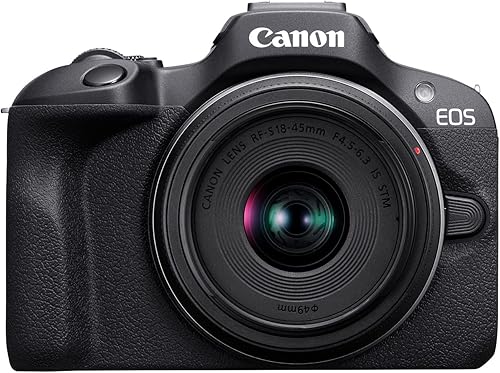
- 24.1 MP APS-C sensor
- RF-S 18-45mm lens
- Dual Pixel CMOS AF
- 4K video at up to 24 fps
A compact EOS R-series alternative with newer autofocus features and 4K recording. Its RF mount differs from the T7's EF mount, so check lens compatibility when building a kit.
Pros
- Compact, lightweight EOS R-series body
- Human face and eye detection
- Up to 6.5 fps in One-Shot AF
Cons
- Fixed rear display
- RF mount lenses differ from EF DSLR lenses
- 4K recording uses the central area of the sensor
The R100's Dual Pixel CMOS AF covers up to 143 zones and includes human face and eye detection. It can shoot up to 6.5 frames per second in One-Shot AF, compared with the T7's 3 fps.
The R100 records 4K video at up to 24 fps and Full HD at up to 60 fps; the T7 records Full HD 1080p.
The R100's included RF-S 18-45mm lens belongs to Canon's RF mount system. The T7 uses EF lenses, including EF-S lenses.
If you already own compatible lenses or expect to build a kit, check the mount before choosing a body. A camera's headline resolution alone will not tell you whether its controls, viewfinder and lens system suit your routine.
When does a Canon Rebel T7 review point you toward the R100?
A canon rebel t7 review should point you toward the R100 if compact size, face and eye detection, or 4K video matter more to you than an optical DSLR viewfinder. Choose the T7 when you prefer that viewfinder and want to use EF or EF-S lenses.
The R100 can also suit a beginner who expects to record video as well as still photos. Its 4K recording uses the central area of the sensor, so consider that framing detail if you expect to make regular 4K clips.
Both cameras offer an interchangeable-lens route, but they lead into different mount systems.
Is the EF 50mm f/1.8 STM a good next lens?
The EF 50mm f/1.8 STM is a portrait and low-light option for T7 owners who want a wider aperture than the kit zoom provides. Its fixed focal length makes it less flexible when you cannot move to change the framing.
Canon EF 50mm f/1.8 STM: Best for portraits and dim scenes

- 50mm focal length
- f/1.8 maximum aperture
- STM autofocus motor
- EF mount
A fixed-focal-length EF lens for T7 owners who want to try portraits or a wider aperture than the kit zoom provides. On an APS-C camera, it has an 80mm effective focal length.
Pros
- f/1.8 maximum aperture
- Near-silent STM focusing for movies
- Compact 5.6 oz lens
Cons
- No zoom
- No image stabilization
- Does not provide the kit zoom's range
On the T7's APS-C sensor, this 50mm lens has an 80mm effective focal length. That narrower view can suit portraits, but it can feel tight in a small room or when you want a wider group photo.
The maximum aperture of f/1.8 lets in more light than the kit zoom's f/3.5-5.6 range. The lens also has an STM motor for quiet, continuous autofocus in movies.
It has no image stabilization, so use a steady hold and pay attention to shutter speed when you shoot in dim light.
What mistakes should T7 beginners avoid?
The most common mistake is expecting a basic DSLR to keep up with every moving subject. For sports and fast wildlife, the focus system and burst rate matter as much as resolution, so set realistic expectations before buying.
Another mistake is buying a longer lens when the real problem is camera movement or poor timing. Practice holding the camera steadily, focus before the moment you want to capture and take a short burst when appropriate.
For a stationary subject, try a few different focus and exposure settings rather than firing many frames without checking the result.
Avoid changing multiple settings at once while learning. Adjust one control, take a picture and review it so you can see what changed.
If an image looks too dark or bright, check exposure settings and lighting before assuming the lens or sensor is the problem.
Finally, don't buy into a lens system without checking compatibility. The T7 uses EF and EF-S lenses, while the R100 uses RF lenses.
A camera-body decision can shape which lenses you can attach directly, so make that choice before adding more gear.
Who should buy the Canon EOS Rebel T7?
Buy the T7 standard kit for everyday photography and a first DSLR learning path; choose the double zoom kit if you need more reach. Pick the R100 if you want a compact mirrorless body, newer autofocus features and 4K video, and consider the EF 50mm f/1.8 STM when portraits or dim scenes become a regular interest.
This canon rebel t7 review comes down to a clear fit: the T7 is a straightforward choice for stills, an optical viewfinder and EF lenses, while its modest autofocus and burst speed make fast action a reason to look elsewhere. For another comparison before deciding, read our guide to choosing a DSLR for beginners.
Frequently asked questions
Is the Canon Rebel T7 good for beginners?
The T7 suits beginners who want an optical viewfinder, interchangeable lenses and a direct way to learn exposure and framing. Its APS-C sensor provides detailed images, while its 9-point autofocus and 3 fps continuous shooting make it a better match for everyday subjects than fast action.
What lens comes with the Canon EOS Rebel T7?
The standard kit includes an EF-S 18-55mm f/3.5-5.6 IS II zoom lens. The double zoom kit adds another zoom lens for more reach, so choose it when distant subjects are a regular part of your photography.
Otherwise, the standard lens is a simpler starting point.
Should I get the Canon Rebel T7 or R100?
Choose the T7 if you want a DSLR with an optical viewfinder and EF lens compatibility. The R100 is a compact mirrorless alternative with Dual Pixel CMOS AF, human face and eye detection, and 4K recording.
Its RF mount uses a different lens system.
Can I use a 50mm lens on the Canon Rebel T7?
Yes. The Canon EF 50mm f/1.8 STM is an EF lens, and the T7 is compatible with Canon EF lenses.
On the T7's APS-C sensor, it has an 80mm effective focal length, which can suit portraits but gives you a narrower view than the kit zoom.


