Canon EOS R10 vs Sony A6400: Which to Buy? (November 2026)
The Sony Alpha a6400 with the 18-135mm kit wins for most first camera buyers because it comes ready to shoot with a versatile zoom lens. Pick the Canon EOS R10 body if you already own RF glass or want faster bursts and longer 4K clips.
On this page (10 sections)
- Canon EOS R10 vs Sony A6400: which is better for a beginner?
- Which camera is built for action?
- Which handles video and vlogging better?
- How do the two lens systems compare?
- How do autofocus systems compare on paper?
- Which suits travel and everyday carry?
- Who should buy the Sony a6400?
- Who should buy the Canon EOS R10?
- Which Nikon and Canon options should you compare first?
- Verdict: is the Canon EOS R10 or Sony A6400 the better buy?
The Sony Alpha a6400 with the 18-135mm kit wins for most first camera buyers because it comes ready to shoot with a versatile zoom lens. Pick the Canon EOS R10 body if you already own RF glass or want faster bursts and longer 4K clips.
Both are compact APS-C mirrorless cameras with 24.2 megapixel sensors, a tilting screen and fast autofocus. The canon eos r10 vs sony a6400 decision comes down to the lens in the box, burst speed and how long you film.
We compared the specs each brand publishes and matched them to the way most people shoot. Neither camera is a poor choice.
They just reward different buyers.

Canon EOS R10 vs Sony A6400: which is better for a beginner?
The a6400 is the better beginner camera because it includes a lens. A camera body alone means a second purchase before you take a single photo, and the R10 ships body only.
The Sony kit pairs the 24.2MP APS-C body with an 18-135mm zoom. That range covers wide group shots and reaches into portraits and distant subjects without changing lenses.
Its autofocus is the headline feature. Sony says the camera finds focus in 0.02 seconds with real-time AF and object tracking, using 425 phase and 425 contrast detection points across 84% of the sensor.
Beginners also get an adjustable tilting LCD. It tilts for vlogging, stills or video, so framing above a crowd or down low is easy.
Which camera is built for action?
The R10 is the action pick, with 15 fps mechanical bursts against 11 fps on the a6400. Both rely on smart subject tracking to keep a runner or pet in focus.
Canon pairs the 24.2MP APS-C sensor with the DIGIC X processor. That combination drives 15 fps mechanical shutter bursts, fast enough to catch a jump mid-air or a dog mid-sprint.
The a6400 counters with 11 fps continuous shooting at 24.2MP raw. That is still quick, and its 425 phase detection points spread across 84% of the frame, so subjects near the edges stay tracked.
If you shoot school sports or fast wildlife, the R10's extra frames per second thin out the moment you miss. For casual family action, either camera keeps up.
- Burst speed: R10 at 15 fps, a6400 at 11 fps.
- Sensor: both use a 24.2MP APS-C chip.
- Focus: Dual Pixel CMOS AF on the R10, real-time AF tracking on the a6400.
Which handles video and vlogging better?
Pick the a6400 for vlogging, and the R10 for long takes and moving subjects. The Sony kit's screen and zoom lens matter more at a desk or on a walk.
The a6400 carries multiple movie functions built in. You can shoot time-lapse clips and slow or quick motion without post processing, and the tilting LCD is designed for solo filming.
The R10 leans toward longer recording. Canon says it records 4K for over 30 minutes without stopping, subject to battery level, card capacity and internal temperature.
Movie Servo AF adds subject detection and tracking while you film.
That combination suits interviews, events and content creators who need a camera to keep rolling. The R10's compact body also fits comfortably in one hand.
How do the two lens systems compare?
The a6400 arrives with a lens; the R10 needs one before it shoots. That single difference shapes the cost and convenience of each kit.
Sony's 18-135mm zoom is the only lens you need to start. It covers landscapes, snapshots and light telephoto work, and the E mount has a wide range of lenses to add later.
The R10 is body only, so you add an RF-S or RF lens. Canon notes that EF and EF-S lenses also fit with the optional Mount Adapter EF-EOS R, which helps if you own older Canon glass.
Both cameras use memory cards and rechargeable batteries, but they are not interchangeable. The a6400 uses an NP-FW50 battery and takes SD, Memory Stick Duo or microSD cards, while the R10 uses an LP-E17 pack and SD, SDHC or SDXC cards.
Sony Alpha a6400 with 18-135mm
Score: 9.4. Best for most buyers.
The a6400 kit is the one to grab if you want one purchase and a lens that does most jobs.
The 24.2MP APS-C sensor sits in a body light enough to carry all day. Sony's 425 phase and 425 contrast points cover 84% of the frame, so a subject off-center still gets tracked.
Bursts reach 11 fps at full 24.2MP raw. The 14-bit bit depth keeps room for editing color and shadow detail in a raw converter.
The body has a built-in flash and wireless connectivity for sending shots to a phone. The tilt screen makes low-angle and self-filming shots easier to frame.
The zoom lens adds range. Its aperture modes cover auto, manual and aperture priority, and the 18-135mm span means you can shoot a landscape and a school play with the same lens.
For a first camera, that flexibility beats a sharper prime that only covers one angle. The result is a kit that handles travel, family and casual video in one bag.
The trade-offs are real. The kit lens is not fast, and the smaller grip is less comfortable with heavy lenses later.
But as a complete package, it is hard to beat.
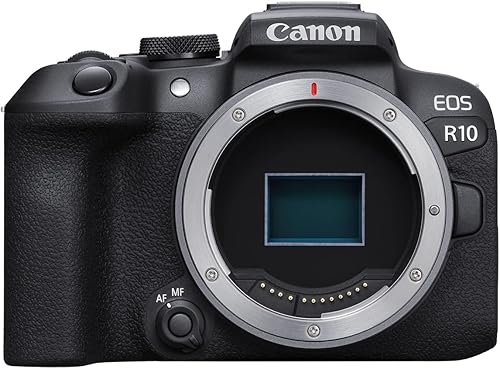
Canon EOS R10 (Body)
Score: 8.5. Best for Canon RF owners.
The R10 shines when you already have RF glass or want speed and long video takes in a light body.
Its 24.2MP APS-C sensor and DIGIC X processor keep noise down and color clean, according to Canon. The processor powers 4K capture and faster handling as you shoot.
Dual Pixel CMOS AF tracks subjects with 651 autofocus points. Subject detection and tracking help in both stills and video, and Movie Servo AF keeps focus moving with your subject.
The mechanical shutter reaches 15 fps for dynamic action. Canon notes that anti-flicker shooting, aperture value or battery life can slow the actual rate, and that continuous shooting is not available with Dual Pixel RAW enabled.
Video runs over 30 minutes per clip, with the usual limits from battery, card capacity and temperature. A built-in flash and hot shoe cover a few lighting needs, and the body is light enough for a small shoulder bag.
The catch is the missing lens. Body only means a required purchase before you can shoot, and RF-S lenses are still a smaller range than Sony E glass.
How do autofocus systems compare on paper?
The a6400 wins on tracking speed, while the R10 wins on autofocus point count. Both are dependable for faces, pets and moving kids.
Sony states a 0.02 sec focus time with real-time tracking, plus 425 phase detection points. That wide spread helps when a subject moves toward a frame edge.
Canon lists 651 autofocus points and Dual Pixel CMOS AF for stills and video. The count is higher, and its subject detection and tracking make it easy to keep a runner in focus.
You cannot split them with a spec sheet alone. The practical difference is that Sony's wide tracking coverage suits fast, unpredictable subjects, while the R10's subject detection suits video where focus has to follow a person.
Which suits travel and everyday carry?
Both are light enough for a day bag, but the a6400 kit covers more shooting angles without extra weight. A camera you leave at home is the worst one you can own.
The a6400 body plus the 18-135mm lens is a single piece to pack. The lens's reach lets you shoot a street scene and a distant detail, which cuts down on lens swaps.
The R10 body is compact and shaped for comfortable holding, and it pairs with RF-S glass. That is a strong travel setup if you own a small RF-S zoom, but it depends on the lens you add.
Neither camera is bulky compared with a DSLR. The key decision is whether you value a single ready kit or a body you build around over time.
Who should buy the Sony a6400?
Buy the a6400 if you want one box that covers stills, video and a useful zoom range. It is the most complete first camera between these two.
It suits the traveler who carries one camera, the parent filming a school event, and the vlogger who needs an adjustable screen and tracking focus.
The fast 0.02 sec autofocus helps with children and pets that move without warning. The 11 fps burst and 24.2MP sensor give you enough raw detail to crop and edit.
For a broader look at starter Canon options, our Canon Rebel T7 review explains what a budget DSLR offers if you want to compare cost and body style.
Who should buy the Canon EOS R10?
Buy the R10 if you already own RF lenses or shoot fast action and long 4K takes. It is the body for a Canon shooter building a mirrorless kit.
It suits a photographer upgrading within the Canon system, a sports parent catching fast movement, and a creator recording interviews or events over 30 minutes.
The 15 fps mechanical burst, 651 autofocus points and Dual Pixel AF make it a capable action body. That speed is the reason many buyers choose it over the a6400 on paper.
If you are weighing other brands, our Canon R10 vs Nikon Z50 II comparison puts the R10 up against a rival APS-C body. It helps if you are still deciding which system to join.
Which Nikon and Canon options should you compare first?
The R10 is the Canon body to compare, but the cheaper R100 is worth a look if budget matters more than bursts. Both use the RF mount.
The R100 trims features to keep cost down. Our Canon EOS R10 vs Canon EOS R100 guide covers where the R10 adds speed and video length, and where the R100 is enough.
The entry-level Rebel DSLR line is another option. Our Canon Rebel T7 vs R100 comparison shows how an older DSLR stacks up against a modern RF-mount body.
Compare the sensors first, then the lens mount, then the speed you actually need. That order keeps you from overpaying for a spec sheet feature you will not use.
Verdict: is the Canon EOS R10 or Sony A6400 the better buy?
The Sony a6400 with the 18-135mm lens is the better buy for most people because it is a complete, fast-focusing kit. The Canon EOS R10 wins only for Canon RF owners and fast-action shooters who already have glass.
Take the a6400 if you want one purchase, a zoom that covers most subjects and focus that tracks subjects around the frame. Its 11 fps bursts and tilting screen cover family, travel and vlogging well.
Take the R10 body if you own RF lenses, need 15 fps bursts and record over 30 minutes of 4K. Its Dual Pixel AF and 651 focus points keep moving subjects sharp.
If lenses are still a blank slate, start with the kit that has one in the box. That single choice decides more of your first year of shooting than any spec difference.
Frequently asked questions
Which camera shoots faster bursts, the R10 or the a6400?
The R10 reaches 15 fps with the mechanical shutter, while the a6400 reaches 11 fps at 24.2MP. Both are fast enough for family sports and wildlife, but the R10 pulls ahead for fast action.
Can the R10 record longer 4K clips than the a6400?
Canon says the R10 records 4K video for over 30 minutes without stopping, with limits from battery, card capacity and temperature. Sony lists multiple movie functions on the a6400 but no comparable single-clip figure here.
Which camera has the better lens mount for a first kit?
The a6400 uses Sony E mount and arrives with an 18-135mm lens, so you can add E-mount glass later. The R10 uses Canon RF; RF-S and RF lenses fit directly, and EF or EF-S lenses need the optional mount adapter.
Do both cameras have a tilting screen?
Yes, both use a tilting LCD screen. The a6400's screen is adjustable for vlogging, stills or video, and the R10's tilting display helps with low and high angles.