Canon Rebel T7 vs R10: Which to Buy? (November 2026)
The Canon EOS R10 is the better camera for most buyers thanks to faster autofocus, 15 fps burst shooting and 4K video. The Rebel T7 is the simpler, kit-heavy budget pick that still teaches the basics well.
On this page (11 sections)
- Quick verdict: is the Canon Rebel T7 or R10 the right camera?
- Canon Rebel T7 vs R10 side by side
- Autofocus: which one holds a moving subject?
- Speed and burst: 3 fps against 15 fps
- Video: Full HD on the T7, 4K on the R10
- Lenses and system: EF on the T7, RF on the R10
- Handling and viewfinder: optical vs electronic
- Battery and card setup
- Which should you buy?
- Is the R10 worth the upgrade from a Rebel T7?
- Final verdict on the Canon Rebel T7 vs R10
The Canon EOS R10 is the better camera for most buyers thanks to faster autofocus, 15 fps burst shooting and 4K video. The Rebel T7 is the simpler, kit-heavy budget pick that still teaches the basics well.
In this canon rebel t7 vs r10 comparison, the gap is really about what you shoot. A portrait or landscape beginner can grow on either body, but anyone chasing moving subjects will feel the T7's limits quickly.
The R10 carries a 24.2MP APS-C sensor and the DIGIC X processor. The T7 pairs a 24.1MP APS-C sensor with the older DIGIC 4+ chip.
Most of the decision comes down to autofocus, speed, video and lens mount. We checked the specs of both and weighed them against how beginners and hobbyists actually shoot.
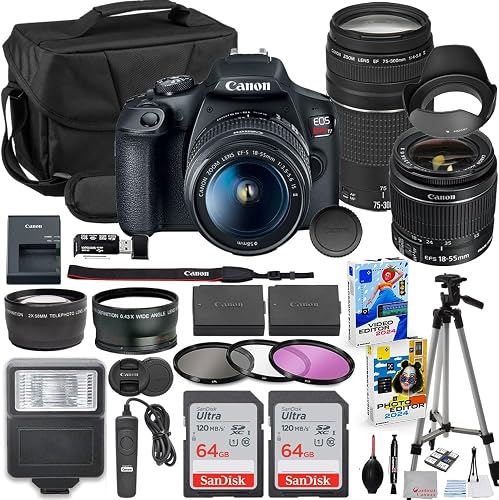

Quick verdict: is the Canon Rebel T7 or R10 the right camera?
Buy the R10 if motion or video is part of your plan; buy the Rebel T7 if you want a complete kit at the lowest entry point. The canon rebel t7 vs r10 question rarely ends in a draw, because the two bodies sit at different stages of Canon's lineup.
The R10 wins on autofocus, burst speed and video. Its 651 autofocus points track subjects, and 15 fps mechanical shooting keeps a burst full of usable frames.
The T7 wins on simplicity and completeness. Its bundle adds an 18-55mm zoom, a 75-300mm telephoto, a spare Canon battery, two 64GB cards and a bag, so day one needs nothing else.
If you already know you want to shoot your kid's soccer games, pick the R10. If you want the cheapest way to learn exposure and lens basics, the T7 does that job and leaves money for a tripod.
Canon Rebel T7 vs R10 side by side
The R10 is the newer, faster and more video-ready body; the T7 is the older DSLR with an optical viewfinder and a generous bundle. Read the table by what matters to you first.
| Spec | Canon Rebel T7 | Canon EOS R10 |
|---|---|---|
| Sensor | 24.1MP APS-C CMOS | 24.2MP APS-C CMOS |
| Processor | DIGIC 4+ | DIGIC X |
| Mount | EF/EF-S | RF |
| Autofocus | 9-point, center cross-type | 651-point hybrid with subject detection |
| Burst | 3 fps | 15 fps |
| Video | Full HD 1080/30p | 4K |
| Screen | 3.0" 920k-dot LCD, fixed | Tilting LCD |
| Viewfinder | Optical pentamirror | Electronic |
| Wi-Fi | Built-in Wi-Fi with NFC | USB connection |
The processor difference shows up in everything else on the table. DIGIC X is built to push 4K frames and track subjects, while DIGIC 4+ is an older design matched to simpler tasks.
The T7 remains a capable stills camera. Its 24.1MP sensor and ISO 100-6400 range cover daylight and indoor work, and the 3.0" LCD is bright enough for menu work.
Neither body is full frame, so you get the same APS-C crop and similar depth-of-field behavior. The bigger split is the mount: EF on the T7 and RF on the R10.
Autofocus: which one holds a moving subject?
The R10's autofocus is the single biggest reason to choose it over the Rebel T7. You'll notice the difference the first time you photograph a running child, a pet or a game.
The T7 uses a 9-point autofocus system with one center cross-type point. That setup is accurate for still subjects and predictable for slow portraits, but it doesn't follow a subject around the frame.
The R10 has 651 autofocus points and subject detection. It picks out faces, animals and vehicles, then keeps them locked as they move, which makes casual action shooting far easier.
For a portrait session on a tripod, both cameras are fine. For a birthday party where the subject won't sit still, the R10 earns its place.
Our Canon EOS Rebel T7 review goes deeper into how the 9-point system behaves day to day.
There's a second point in favor of the R10: live view. The T7's contrast-detection autofocus is slower in live view than through the optical finder, while the R10 is built around live view and the tilting screen.
Speed and burst: 3 fps against 15 fps
Twelve frames per second of difference may sound small, but 3 fps against 15 fps is the gap between one usable action frame and a full sequence. Choose by whether your subjects move.
At 3 fps, the T7 takes about three pictures in the time a fast runner crosses a frame. You'll catch moments, but your timing has to be good, and you'll often accept the best of two or three.
The R10 fires at 15 fps with the mechanical shutter. A short skateboard trick or a dog running to you produces a sequence you can sort through, and the autofocus tracking follows the subject through it.
Faster bursts also help with self-portraits on a tripod and group shots where someone always blinks. The R10 lets you take several frames and pick the clean one.
The T7's 3 fps suits landscapes, still life, portraits and architecture. If none of your subjects move quickly, the difference is easy to live without.
One caveat: fast bursts fill memory cards quicker. The T7 bundle includes two 64GB cards, which is part of why the kit is a comfortable starter set.
Video: Full HD on the T7, 4K on the R10
The R10 records 4K video and runs past 30 minutes per clip, while the T7 stops at Full HD 1080/30p. For vlogging, social clips or anything you plan to crop, the R10 is the clear pick.
4K gives you room to crop a vertical clip from a horizontal frame and still keep detail. It also holds up better on a large TV or monitor, where 1080 footage starts to soften.
The R10's tilting LCD helps when the camera is aimed at your face or positioned low. The T7's screen is fixed, so high and low angles mean guessing the framing.
The R10 also includes Movie Servo AF with subject tracking, which keeps you in focus while you speak or move. The T7's live-view autofocus is slower and less reliable for that use.
The R10 has a practical recording benefit for long takes. Canon says it records over 30 minutes, though the clip can still stop if the battery empties, the card fills or the camera gets too warm.
The T7 is enough for short family clips and occasional YouTube uploads. If video is half your plan, put the money toward the R10.
Lenses and system: EF on the T7, RF on the R10
The T7 opens the door to decades of EF and EF-S glass; the R10 starts a newer RF lens path. Think about what you want to add after the kit lens.
The T7's bundle already includes two lenses. The EF-S 18-55mm f/3.5-5.6 IS II covers a 28.8-88mm equivalent range for everyday shots, and the EF 75-300mm f/4-5.6 III adds a portrait-to-medium-telephoto reach for sports and wildlife.
That second lens matters. Many first-time buyers add a telephoto later, and the T7 kit includes one from the start.
The R10 kit includes the RF-S 18-45mm f/4.5-6.3 IS STM, a compact zoom built for the smaller RF-S format. It's lighter than the T7's standard zoom, and the body is 13.5 oz, so the pair travels easily.
RF lenses tend to cost more than equivalent EF glass, which is the real trade-off of the newer mount. The R10 can take EF and EF-S lenses, but only with the optional Mount Adapter EF-EOS R.
If you already own EF glass, the R10 body plus an adapter keeps that investment alive. If you're starting fresh and budget is tight, the T7 kit's pair of lenses is hard to match.
For a closer look at how the T7 compares with a newer entry body, read our Canon Rebel T7 vs R100 comparison.
Handling and viewfinder: optical vs electronic
The T7 gives you an optical viewfinder with near-zero lag; the R10's electronic finder shows exposure and settings live. Neither is better in every case.
An optical finder, like the T7's pentamirror, shows the scene as your eye sees it. Battery life benefits too, since the screen and finder don't need constant power.
The R10's electronic viewfinder previews exposure, white balance and focus coverage. You see the shot before you take it, which shortens the learning curve on manual settings.
The T7 is compact and lightweight, and its grip suits long walks. The R10 is also compact, at 13.5 oz for the body, with a firm grip made for one-handed carrying between shots.
Controls differ in depth. The T7 keeps things simple with scene modes and Creative Filters, including Scene Intelligent Auto for beginners.
The R10 expects a bit more from you but offers subject detection and faster settings changes once you learn the layout.
If you like the look of the world through a lens, the T7 feels familiar. If you like seeing every setting before you press the shutter, the R10 teaches faster.
Battery and card setup
The T7 bundle includes a spare LP-E10 battery and two 64GB SD cards; the R10 kit includes one LP-E17 battery. Plan the extras you'll need on day one.
The T7's second battery and pair of memory cards make it a true out-of-the-box kit. You can shoot a full day and swap cards without another purchase.
The R10 runs on the LP-E17 battery pack and can charge it inside the camera through the USB Power Adapter PD-E. That makes topping up on the go easier if you carry a power bank or laptop.
Both cameras take SD cards, and the R10 accepts SDHC and SDXC. Fast cards help the R10's 15 fps bursts clear the buffer quickly.
If you buy the R10 body only, you'll also need a lens and a memory card. Budget those alongside the camera so the total makes sense.
Which should you buy?
Most readers should buy the Canon EOS R10 kit; the Rebel T7 is the better buy for the lowest-cost start and the widest lens value. Your subject and budget decide the rest.
Pick the R10 lens kit if you photograph kids, pets, sports or events, or if you want 4K video and a tilting screen. The 651-point autofocus and 15 fps burst are the features you'll notice every time you shoot.
Pick the R10 body only if you already own RF glass or plan to adapt EF lenses. It keeps the same autofocus and video strengths without paying for a second standard zoom.
Pick the Rebel T7 bundle if you're learning photography on a tight budget and want two lenses, a spare battery, cards and a bag in one purchase. Its 24.1MP sensor and simple controls produce good stills, and the 75-300mm lens lets you try telephoto work early.
Skip the T7 if fast action or video is central to your plan. The 9-point autofocus and 3 fps burst will frustrate you more than the savings help.
For a different mirrorless alternative, see our Canon R10 vs Nikon Z50 II comparison.
Is the R10 worth the upgrade from a Rebel T7?
Yes, if you've outgrown the T7's autofocus or want 4K video. No, if you mostly shoot still subjects in good light.
Upgrade when a specific limitation is costing you shots.
The clearest signs are missed action frames, soft video and a wish for a tilting screen. Each of those points to the R10's strengths.
The DSLR still wins on cost of entry and on the immediate value of the bundle. A beginner with no lenses gets more shooting done on day one with the T7.
If you're weighing the R10 against Canon's other entry mirrorless body, our Canon EOS R10 vs EOS R100 comparison covers where the cheaper model trims features.
Final verdict on the Canon Rebel T7 vs R10
The Canon EOS R10 wins this canon rebel t7 vs r10 matchup for most buyers, and the Rebel T7 stays the best budget entry into DSLR photography. Choose the R10 for speed, autofocus and video; choose the T7 for value and a complete starter kit.
The R10's DIGIC X processor, subject detection and 15 fps burst are real advantages you'll feel on moving subjects. The T7's bundle and low entry point make it the smarter first camera for a patient beginner.
Decide by your main subject. If it moves, buy the R10.
If it sits still and your budget is the priority, the Rebel T7 will teach you the basics without overspending.
Frequently asked questions
Is the Canon Rebel T7 or R10 better for a beginner?
The Rebel T7 is the gentler start because its bundle includes two lenses and the controls are simple. Buy the R10 instead if your kids, pets or sports are the main subject, since its autofocus tracks moving things far more reliably.
Can I use Rebel T7 lenses on the R10?
Yes, with the mount adapter EF-EOS R. EF-S and EF lenses fit the adapter and then the R10's RF mount.
The adapter isn't in the R10 body box, so budget for it if you already own T7 glass.
Does the R10 shoot better video than the T7?
The R10 records in 4K and runs past 30 minutes per clip, while the T7 tops out at Full HD 1080/30p. For vlogging, social clips or anything you plan to crop, the R10 is the stronger choice.
Which camera has better autofocus for sports?
The R10. Its 651 autofocus points use hybrid detection with subject tracking, and it fires at 15 fps.
The T7 uses a 9-point system with one center cross-type point and shoots at 3 fps, so fast movement is harder to catch.
Do both cameras have Wi-Fi?
The Rebel T7 has built-in Wi-Fi with NFC for phone transfers and remote control through the Canon Camera Connect app. The R10 kit lists USB connectivity and no Wi-Fi in its specs, so plan wireless sharing around another device.


